Every August, nonprofits launch Make-A-Will Month (MAWM) campaigns hoping to inspire supporters to take action on estate planning. The campaigns that generate the strongest engagement are rarely the ones that are loudest in promoting document compilation. Instead, they’re the ones that make planned giving feel emotionally relevant, mission-aligned, and genuinely useful.
Moreover, the most successful organizations do not treat Make-A-Will Month as a standalone planned giving promotion. They integrate it into the stories, values, and experiences supporters already care about.
We wanted to share what our partners have found works well, and some of the strategies they’ve used to capitalize on the momentum of MAWM, build lasting awareness, and turn August into a launchpad for year-round engagement rather than a one-time campaign moment.
Build an Entire Campaign, Not Just a Single Email
One email is rarely enough to spark meaningful engagement. In fact, traditional marketing trends suggest people typically need to encounter a message at least seven times before taking action. That’s why the strongest MAWM strategies tend to use a multi-channel, multi-touch approach that keeps the message visible, consistent, and easy to engage with over time.
One Giving Docs partner who executed this beautifully last year was Nebraska Public Media. They developed and executed a true multi-channel campaign, layering awareness over a course of 6+ weeks with teaser messaging, email outreach, social content, and on-air promotion.
Their rollout included:

- A July teaser newsletter announcing the partnership
- An August campaign featuring three emails
- Social media promotion
- On-air messaging
This kind of repetition creates familiarity without overwhelming supporters. Different audiences engage through different channels, and repeated exposure increases action.
Importantly, the messaging was not simply repeated word-for-word. The campaign created multiple touchpoints around the same core theme.
What to try:
- Start teasing Make-A-Will Month before August
- Create an email series instead of a single send
- Coordinate messaging across social, email, web, and offline channels
- Repackage the message from different angles
Why it works:
Estate planning is rarely an impulse action. Multi-channel visibility keeps the opportunity top-of-mind until supporters are ready to engage.
Lead With Education Before Asking for Action
One of the biggest barriers to creating a will is uncertainty.
Many supporters assume:
- they do not own enough assets to even have “an estate”
- they are too young
- wills are too complicated or expensive
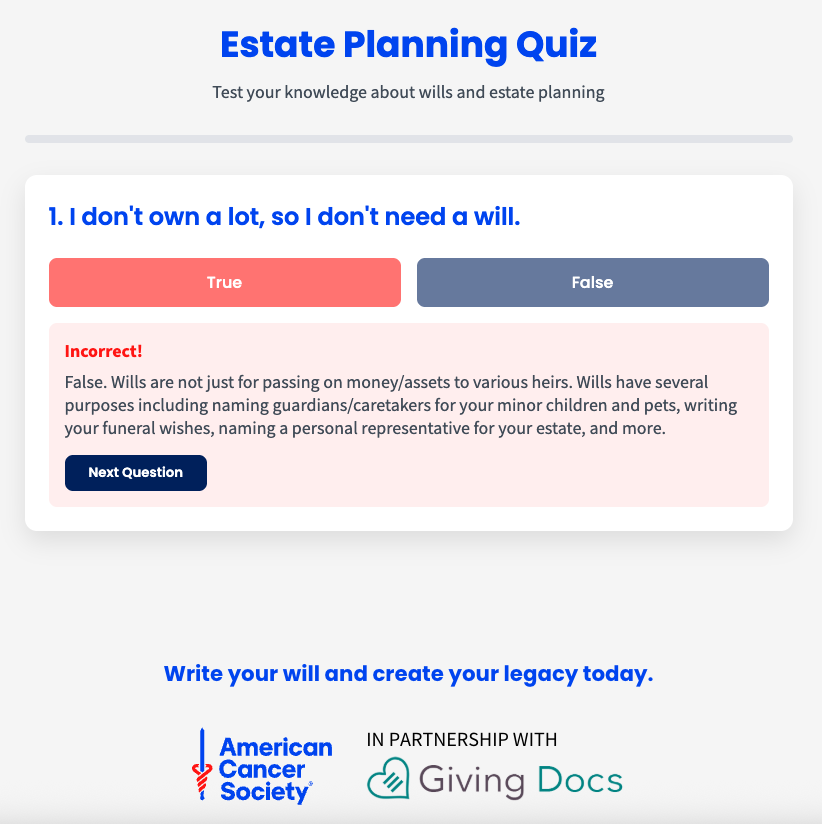
The American Cancer Society tackled this challenge head-on with one of the most creative educational assets we saw this Make-A-Will Month: an interactive estate planning quiz.
The quiz addressed common misconceptions through true/false questions and guided supporters toward action in a low-pressure, engaging way.
Their campaign also included:
- digital outreach
- internal toolkits for fundraisers
- educational content designed to normalize estate planning conversations
Rather than immediately asking supporters to “create your will,” ACS focused first on building confidence and understanding.
What to try:
- Create myth-busting content
- Use quizzes, FAQs, or interactive education
- Equip internal teams with talking points
- Frame estate planning as accessible and relevant for everyone
Why it works:
Gamification reduces intimidation. When supporters feel informed, they are significantly more likely to take the next step.
Build a Campaign That Resonates With Your Audience
The best-performing campaigns did not look generic.
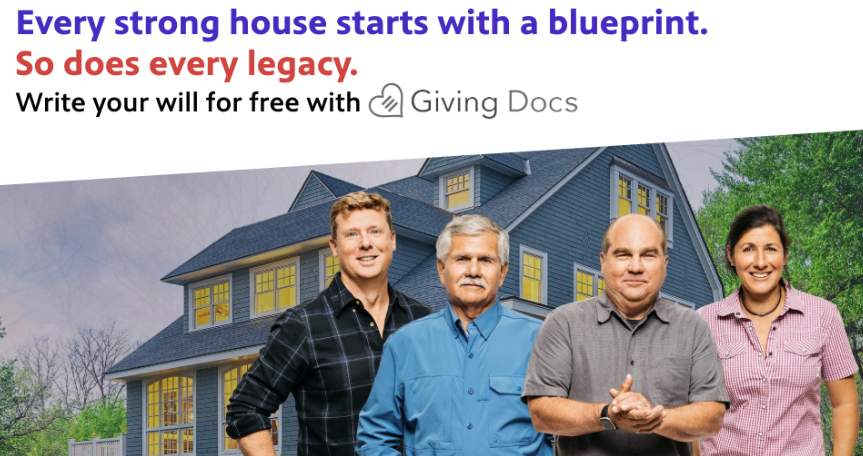
Kansas City PBS created one of the most memorable Make-A-Will Month campaigns by leaning fully into their brand identity and incorporating beloved PBS personalities and nostalgic imagery into campaign creative.
The result was:
- emotionally resonant
- highly shareable
- mission-aligned
- effective at driving engagement and account activations
The campaign succeeded because it did not feel like a templated estate planning promotion. It felt unmistakably PBS.
That familiarity matters.
Supporters are far more likely to engage when planned giving messaging feels like a natural extension of the organization they already know and trust.
What to try:
- Incorporate recognizable visual assets or personalities
- Use storytelling that reflects your organization’s tone and identity
- Lean into emotional familiarity and community connection
- Avoid overly corporate or legalistic creative
Why it works:
Brand familiarity builds emotional trust and emotional trust drives action.
Don’t Underestimate the Power of Human Connection
Even in highly digital campaigns, outreach that feels deeply human will always be the most effective.
The Episcopal Church Foundation paired digital outreach with a surprisingly effective high-touch strategy: personal follow-up and call center support.
Their campaign included:
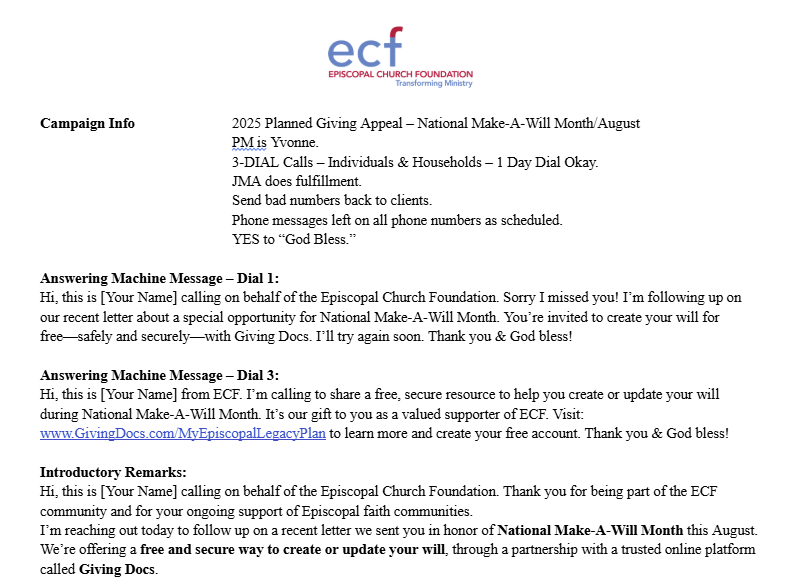
- email marketing
- social media
- website pop-ups
- direct mail
- personalized phone outreach
In a world saturated with digital messaging, direct human connection helped supporters feel guided and supported through the process.
That is particularly important in planned giving, where trust and relationships remain central.
What to try:
- Follow up digital campaigns with personal outreach
- Equip callers or frontline staff with simple talking points
- Use relationship-based stewardship alongside automation
- Consider high-touch follow-up for engaged supporters
Why it works:
Planned giving is deeply personal. Supporters often need reassurance, encouragement, and conversation, not just information.
BONUS TIP: Connect Planned Giving Directly to Your Mission
The strongest planned giving campaigns lead with purpose – not legal language.
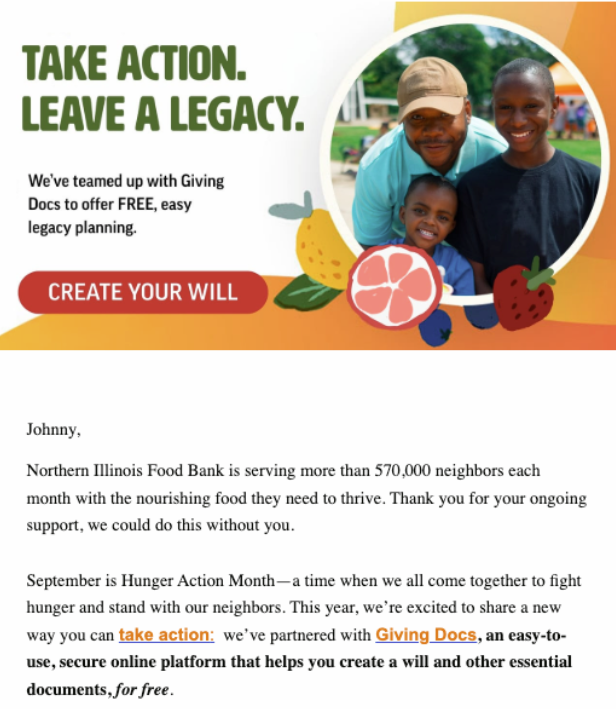
Northern Illinois Food Bank offered a standout example by integrating Giving Docs into Hunger Action Awareness Month messaging, positioning legacy planning as another way supporters could help fight hunger and care for their community.
Instead of saying:
“Create your will.”
The campaign effectively communicated:
“Protect the people and causes you love.”
That subtle shift matters.
When planned giving language feels disconnected from your organization’s core mission, supporters can perceive it as transactional or out-of-place. But when it becomes an extension of the impact they already believe in, engagement becomes far more natural.
What to try:
- Tie planned giving into an existing awareness month or campaign
- Use mission language before planned giving language
- Show how legacy gifts continue the impact supporters already care about
Why it works:
Mission alignment lowers emotional friction. Supporters instantly understand why your organization is talking about planned giving and why it matters.
The Biggest Lesson From Last Year’s Best Campaigns
The organizations generating the strongest results are not treating planned giving like paperwork, they treat it like mission storytelling.
Whether through education, nostalgia, multi-channel visibility, or personal connection, the most effective campaigns helped supporters see planning for their future as an expression of their values and impact.
That is when Make-A-Will Month becomes more than a fundraising initiative. It becomes an opportunity to deepen supporter relationships while helping people protect what matters most.
At Giving Docs, we are proud to support nonprofits building Make-A-Will Month campaigns that feel mission-aligned, human, and genuinely engaging.
Planning your next campaign? We would love to help.