

Each year, Giving USA takes stock of philanthropy across the country. This year’s findings brought real reasons for optimism: total charitable giving reached an estimated $617.2 billion in 2025, the highest level ever recorded.
But the headline number only tells part of the story. For planned giving professionals, the more important insights are in the trends. How donors are thinking about impact, and where legacy giving fits into that picture.
For organizations investing in planned giving, this report isn’t just good news. It’s one of the clearest signals yet that legacy giving is becoming a meaningful driver of long-term philanthropic growth.
Here are five takeaways worth the attention of every nonprofit leader and gift planner.
1. Bequests Didn’t Just Grow. They Drove Growth.
The most striking number in this year’s report is one that many general fundraising headlines overlooked: bequest giving increased 19.7% year over year, reaching $62.19 billion.
To put that in perspective, individual giving increased 4.1%, foundation giving increased 5.7%, and corporate giving increased 3.1%. No other source of charitable giving came close to matching the growth rate of bequests.
For planned giving professionals, this matters because it challenges a longstanding assumption that legacy giving is primarily a future opportunity. The Giving USA data suggests that planned gifts are having a meaningful impact right now.
In raw dollars, bequests added more than $10 billion in charitable revenue compared to the prior year. That’s not incremental growth around the edges of philanthropy. That’s one of the largest drivers of growth in the sector.
The takeaway isn’t that every nonprofit should suddenly shift resources away from annual fundraising. Rather, it’s that organizations that have invested in building legacy societies, promoting estate gifts, and stewarding long-term donor relationships may be beginning to see those investments pay off.
2. The Great Wealth Transfer May Be Becoming More Than a Projection
Few trends have received more attention in philanthropy over the past decade than the Great Wealth Transfer. Estimates vary, but most predict that tens of trillions of dollars will pass from one generation to the next over the coming decades.
The challenge has always been that the conversation felt largely theoretical.
Gift planners have been told for years that a historic transfer of wealth is coming. Yet it has often been difficult to point to clear evidence that those forecasts were already influencing charitable revenue.
This year’s Giving USA report may offer one of the strongest signals yet.
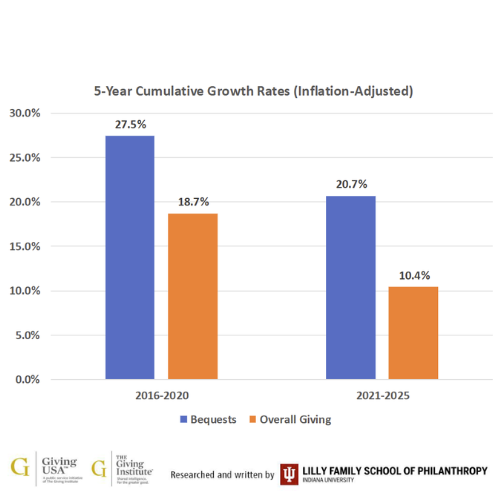
Of course, one year of data does not prove a long-term trend. Many factors can influence realized bequest distributions, including market performance, estate administration timelines, and demographic shifts. But a nearly 20% increase in bequest giving is difficult to dismiss as statistical noise.
At a minimum, the findings raise an important possibility: some portion of the wealth transfer conversation may already be showing up in nonprofit revenue. Bequest giving has grown considerably with three of the last four years seeing 20%+ growth (current dollars).
Organizations that have spent years cultivating donor relationships and normalizing legacy conversations may be entering a period where those efforts become increasingly visible in financial results.
3. The Strongest Growth Happened Where Donor Identity Runs Deep
Several of the strongest-performing categories share something important in common. Giving to education increased 11.7%. Public-society benefit organizations increased 11.6%. Environment and animal organizations increased 11.0%.
While these organizations serve very different missions, many excel at building identity-based relationships with donors.
People don’t simply support a university. They identify as alumni. They don’t merely donate to environmental causes. They see conservation as an extension of their values. They don’t just support community institutions. They view themselves as part of a broader movement or mission.
This matters because planned giving is often deeply connected to identity. A bequest isn’t typically a transactional gift. It’s one of the most personal philanthropic decisions a donor can make. In many cases, it reflects how someone wants to be remembered and what values they hope will continue beyond their lifetime.
For nonprofits, the lesson may be that legacy giving programs are strongest when they focus less on technical gift vehicles and more on helping donors connect their personal story to the organization’s future.
4. Individual Donors Still Matter More Than Everything Else Combined
Amid all the excitement around bequests, donor-advised funds, and institutional philanthropy, it’s worth remembering one simple fact: Individuals contributed $394.2 billion in 2025. That represents nearly two-thirds of all charitable giving in the United States.
For planned giving professionals, this serves as an important reminder that legacy giving and annual giving are not competing priorities. In most cases, they are part of the same donor journey.
The vast majority of planned gift donors begin as annual supporters. They attend events, respond to appeals, volunteer, advocate, and deepen their engagement over time. Eventually, some decide to include the organization in their estate plans.
When organizations treat planned giving as separate from broader donor engagement efforts, they risk missing opportunities to identify and cultivate future legacy donors.
The strongest planned giving programs are often built on strong donor experience programs.
5. Long-Term Commitment Still Wins
Perhaps the most encouraging takeaway from this year’s report is what it says about donor behavior more broadly. Despite economic uncertainty, market volatility, inflation concerns, and shifting philanthropic trends, charitable giving reached a record high.
Donors continue to support causes they care about.
More importantly for gift planners, many donors continue to make commitments that extend far beyond a single campaign or calendar year. That’s ultimately what bequest growth represents. Not just larger gifts, but longer horizons. At its core, planned giving is an act of trust. It’s a donor saying, “I believe this mission deserves to continue after I’m gone.”
This year’s Giving USA findings suggest that many donors are still willing to make that commitment. And for nonprofits willing to invest in relationships, stewardship, and meaningful conversations about legacy, that may be the most important takeaway of all.
The Common Thread: Relationships Drive Results
Bequest growth. The Great Wealth Transfer. Identity-driven giving. The continued dominance of individual donors. Long-term donor commitment. At first glance, these may seem like separate trends. In reality, they all point to the same conclusion: relationships remain philanthropy’s most valuable asset.
If there’s one lesson nonprofit leaders should take from this year’s report, it’s that legacy giving doesn’t happen in isolation. Bequests grow when relationships grow. They grow when donors feel connected to a mission, trust an organization, and can see the lasting impact of their support. The organizations seeing success today are often the ones that have been planting those seeds for years – and this year’s Giving USA findings suggest those investments are paying off.